


Play N Guess: Earn Money
4.7154.00 Reviews
App Specs
- Version
- 1.0.0
- Updated On
- License
- Free
- Downloads
- 100,000+
- Developer
- InventBros
- Categories
- Trivia
- Platform
- Android
Screenshots
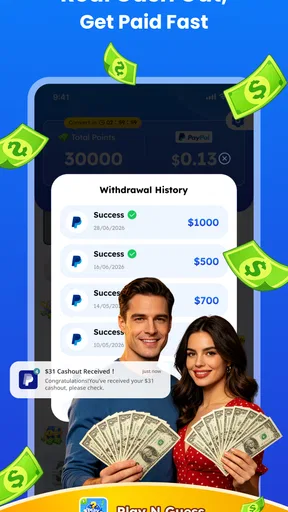
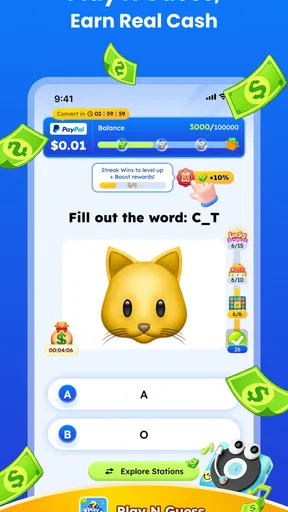
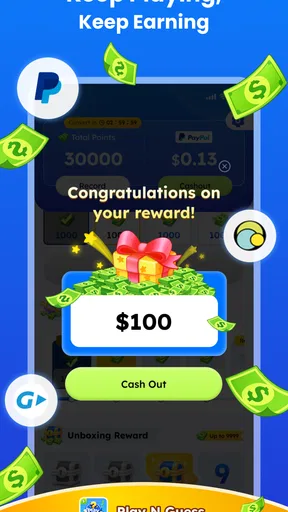
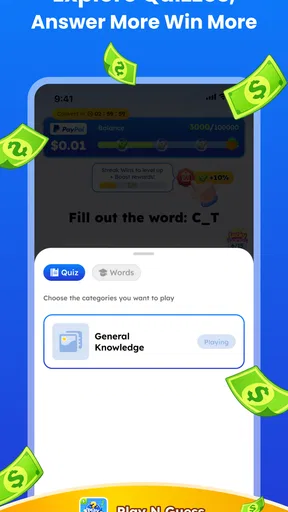
 Analysis by AppCompare
I would approach Play N Guess: Earn Money with two questions in mind: do I enjoy answering trivia for its own sake, and am I comfortable trying a game that presents real rewards as part of the experience? That distinction matters. Trivia can be a pleasant way to fill a short break, but rewards should be a possible extra rather than the only reason to play. If the questions are enjoyable, the game has a reason to hold your attention even when you are not thinking about an outcome.
This is a free trivia game from InventBros, currently at version 1.0.0. Its store summary points to fun questions and real rewards, so the appeal is easy to understand: test what you know, enjoy a quick mental challenge, and see where the reward angle leads. I would treat that promise as an invitation to look more closely, not as a guarantee of income. For a player deciding whether to try it, the useful question is whether the trivia itself sounds like a good fit.
What to decide before you start
I’d begin by deciding what would make a quiz session worthwhile for me: enjoying the questions, having a focused break, or exploring the reward angle. That choice gives me a fair standard for judging the game instead of letting a hoped-for outcome set it. I’d also think about when I usually play, since a trivia session fits a spare moment better than a task that needs my full attention.
Choose it for trivia first
I find it helpful to separate the game’s two hooks. The trivia is the activity; rewards are a reason some people may be curious about it. If I am in the mood to recall facts, make guesses, and see how I do, that first hook is enough to justify a try. If I only want a reliable way to earn money, a trivia game is a poor category to rely on: entertainment and reward-based play are not the same as predictable paid work.
That is also how I would set expectations for a first session. I would focus on whether the questions keep me engaged and whether the general experience feels worth returning to, rather than treating an early result as proof of what I can earn over time. Rewards can be motivating, but they should not turn a casual game into a financial plan. Enjoy the quiz; regard any reward as a bonus, not an income promise.
Check whether the age rating fits
The game carries a Mature 17+ content rating. That makes it unsuitable as a default choice for younger players, even if someone is mainly interested in trivia. I would check that rating before installing it for a teenager or handing over a device. In a household where games are shared, it is worth considering the age guidance rather than judging suitability from the word “trivia” alone.
It is free to install, which lowers the initial barrier to trying it, but free does not automatically mean that every part of an experience will suit every player. I would still pay attention to what the game asks me to do and whether I am comfortable with its approach to rewards. A sensible rule is to avoid spending money or sharing information simply because a game suggests that doing so might improve an outcome.
Worth Reading Before You Choose

EA SPORTS FC Mobile 26 Is a Bigger Football Game, but It Takes Time

Flipboard Shows What News Apps Must Do Beyond the Feed

Switching to Android Auto Means Rethinking Your Driving Routine

Google Calendar Makes a Crowded Week Easier to Manage

Ludo King Makes the Most of the Minutes Between Plans

Baby Panda World Brings Quick Play to Modern Phones, but Its Game Library Feels Busy
What its popularity can—and cannot—tell you
Play N Guess has an average rating of 4.7 from around 1,500 ratings, with about 155 written reviews and over 100,000 installs. Those figures suggest that plenty of people have been willing to try it and that the overall response has been positive. They are useful as a broad confidence signal, but they cannot tell me whether its question style, reward expectations, or pace will match my own preferences.
I would use those signals as a reason to consider a trial, not as a substitute for deciding what I want from a trivia game. A high average cannot guarantee that a particular player will like the questions, and install totals do not show how often people return. For me, the practical test is simple: after a short play session, do I want another round even if I set the reward angle aside?
Where this game may win you over
What draws me in here is the combination of a familiar quiz activity and a reason to feel more invested in each answer. I’d judge that combination by whether it makes the break more enjoyable, not by how intensely it encourages me to keep going. A useful personal test is whether I’d still choose a round when I’m simply in the mood for trivia.
A more purposeful spin on a quiz break
Compared with a familiar quiz app that focuses entirely on answering questions, Play N Guess adds a reward-oriented reason to participate. That can make it more appealing to someone who likes a small sense of purpose alongside trivia. If I have a few idle minutes and want to do something more active than scroll, a quiz is a natural fit: I have to think, retrieve information, and commit to an answer rather than simply consume a feed.
The important trade-off is that this extra hook changes what some players expect. A pure trivia fan may be content with good questions and a satisfying challenge. A reward-motivated player may judge the whole experience by what the rewards mean in practice. I would therefore recommend approaching it as a trivia game with a reward theme, rather than assuming the theme is a dependable substitute for a conventional job or a guaranteed payout.
Useful in short, low-pressure moments
A realistic use case is a quiet break between tasks: I could open the game while waiting for a friend, sitting through a short commute, or taking a pause at home. Trivia suits those moments because it gives the break a clear activity without requiring me to plan a long session. I would avoid starting it when I need to concentrate on something else, though. Once I begin trying to recall answers, even a casual quiz can pull my attention away from a conversation or a task.
Another useful approach is to treat a session as a small test of my own knowledge rather than a performance. If I miss questions, that can still be part of the fun; the point is not to prove expertise every time. This mindset also helps keep reward expectations in check. The session has value if the quiz is entertaining, while any reward should remain secondary to the time I chose to spend playing.
Try it with a clear personal limit
For a first visit, I would decide in advance how much time I want to give it. That is a practical way to judge whether the game fits into my routine without letting a reward-focused loop take over a break. Afterward, I would ask myself whether I enjoyed the trivia, whether the reward element made the experience more engaging or more distracting, and whether I would play again without expecting a particular result.
This small check is more useful than downloading every reward-based game that appears in a search. It gives me a personal comparison point: perhaps I like trivia but not the extra incentive, or perhaps the added motivation is what makes me open the game at all. Either answer is valid. The key is to notice which part is actually delivering value for me.
When another kind of game may fit better
The better alternative depends on the kind of thinking I want to do: focused fact questions, a logic challenge, or something suitable for a mixed-age group can call for different games. I’d make that choice before installing rather than expecting one trivia title to cover every mood. The age guidance matters especially when a device is shared, so I’d check suitability for everyone who might use it.
Pure trivia is better for question-focused players
If my main goal is to learn facts, practise a subject, or compare knowledge with friends, a conventional trivia app may be a better match. Those alternatives can put the questions and quiz format at the center, without making rewards part of my decision. That does not make them universally better; it simply gives a player a clearer choice if reward mechanics feel like a distraction or create expectations they do not want.
Play N Guess makes more sense when the reward angle is part of the appeal and I am still happy to treat the game as entertainment. If I find myself measuring every round only by what I might receive, I would switch to a quiz focused on knowledge or competition instead. That is not a criticism of the game so much as a useful way to avoid choosing the wrong tool for the job.
Casual puzzles are better when I want variety
There are also moments when I want a quick challenge but do not want to answer factual questions. Word games, logic puzzles, and other casual activities can offer a different kind of mental break. They may suit me better when I prefer solving something step by step rather than recalling information. A trivia game is most satisfying when the knowledge-and-guessing format is what I want, not merely because it happens to be available.
For shared play, I would also think about the group. A quiz can be a convenient conversation starter if everyone is comfortable with the format, but a reward-centered game is not automatically the best choice for a family gathering or a mixed-age group. The 17+ rating makes that particularly important. For younger players or a group that wants a universally suitable activity, an age-appropriate alternative is the safer decision.
Skip it if you expect reliable earnings
The clearest reason not to choose this game is a strict expectation of predictable income. “Real rewards” can sound compelling, but that phrase alone does not tell me how a player’s effort translates into a result. I would not install it to cover expenses, replace paid work, or justify spending money. If a reward opportunity requires a decision that makes me uncomfortable, I would stop and reconsider rather than press on because I had already invested time.
That caution does not mean the reward idea has no appeal. It means the game should be judged by the experience I actually get, not by an assumption that every session will produce a meaningful return. Players who enjoy quiz games and are curious about the incentive may find that balance reasonable. Anyone who would feel disappointed without a guaranteed financial outcome should choose another kind of activity.
Making the switch without overthinking it
I’d make any switch a small experiment rather than abandoning a game I already enjoy. Try a brief session, then compare how the activity felt with your usual choice and whether the reward angle added interest or distracted you. If it stops feeling like a pleasant use of a break, I’d move on; keeping that simple boundary makes the decision easy.
Keep your test simple
Moving from another quiz app to this one does not need to be a big commitment. I would try it on its own terms: play enough to see whether the trivia feels enjoyable, then compare that feeling with what I get from my usual alternative. If I miss a more focused quiz experience, I can return to that. If the added reward angle makes a short session more interesting without changing my expectations, then it may earn a place among my casual games.
I would not assume that skills or habits from another app will translate into identical results here. Different trivia games can feel different even when they share a broad category, and a reward-oriented approach can affect what I pay attention to. Rather than trying to optimise immediately, I would first learn how I feel about the activity itself. A low-pressure trial tells me more than chasing an outcome before I know whether I enjoy playing.
Use a stop rule if the incentive takes over
A helpful personal boundary is to stop when the game no longer feels like a worthwhile break. If I notice that I am continuing only because I feel I have to recover time already spent, that is a good moment to close it. The same applies if I feel pushed to make a choice I would not otherwise make. This is a practical safeguard for any reward-oriented game, and it keeps entertainment from becoming an obligation.
Because the game is free, trying it does not require an upfront purchase. Still, I would judge the cost in time and attention as well as money. A few minutes spent on a quiz can be enjoyable; repeatedly checking for an outcome that does not feel worthwhile is a different experience. The best comparison is not “free versus paid,” but “is this a better use of my break than the other options I have?”
My recommendation for the right player
Play N Guess is worth considering if you already enjoy trivia, want a casual quiz to fill spare moments, and are curious about a game that includes real rewards in its pitch. InventBros’ game has a strong average rating of 4.7, and its popularity gives a new player a reason to take a look, but neither fact should replace a personal trial. I would install it with modest expectations, check that its Mature 17+ rating is appropriate for me, and decide based on the quality of the experience rather than an imagined return.
I would skip it if I want guaranteed earnings, a learning-focused quiz with no reward angle, or a game suitable for younger children. A different trivia app may be better for serious knowledge practice, while a puzzle game may fit better when I want reasoning rather than recall. Those are meaningful differences, not small details: choosing by the kind of break I want makes it easier to enjoy the game I pick.
For me, the strongest way to think about Play N Guess: Earn Money is as an optional trivia diversion, not a money-making plan. If a short quiz sounds fun on its own, the reward element can be an interesting extra to explore. If it is the only reason I would play, I would keep looking. That is a clear, fair way to give the game a chance without asking it to be something it may not be.
Pros
- Quick rounds make it easy to play during short breaks.
- The guessing format is simple to understand for new players.
- A lightweight game style may suit casual
- occasional play.
- Answering questions can make the experience more engaging than passive ads.
- It offers a chance to test general knowledge while playing.
Cons
- Cash rewards may depend on eligibility
- location
- and account requirements.
- Earnings are not guaranteed and may take time to accumulate.
- A minimum payout threshold could delay access to rewards.
- Frequent ads or promotional tasks may interrupt gameplay.
- Reward availability and withdrawal options may change over time.
FAQs for Play N Guess: Earn Money
What is Play N Guess: Earn Money?
Play N Guess: Earn Money is presented as a mobile game in which players answer or guess prompts and may receive rewards for taking part. The exact questions, game modes, and reward options can vary by version and location, so check the app’s current store listing and in-app terms before installing. Treat it as an entertainment app with possible rewards, not as a guaranteed source of income.
Can I really earn money with Play N Guess: Earn Money?
The app’s name suggests that gameplay can lead to rewards, but that does not guarantee that every player will earn cash or be able to withdraw a particular amount. Reward availability may depend on completing eligible activities, reaching a minimum balance, and meeting regional or account requirements. Read the withdrawal rules carefully, including any fees, limits, or expiration conditions, and never spend money expecting a guaranteed return.
How do I withdraw rewards from the app?
Withdrawal methods and requirements can change, and they may differ between countries or app versions. Before spending time accumulating rewards, open the app’s rewards or payment section and check which payout options are actually available to you, the minimum amount required, and any identity or account verification steps. Also review processing times and restrictions; a displayed balance may not mean that funds are immediately payable.
Is Play N Guess: Earn Money safe to download?
Use the official Google Play or Apple App Store listing where the app is available, and review the developer details, recent user feedback, privacy information, and requested permissions before installing. A rewards app may handle account or activity data, so make sure its privacy policy explains how that information is used. Avoid unofficial download files and do not share passwords, payment details, or sensitive documents unless the need is clearly explained.
Is Play N Guess: Earn Money free, and what should I check before playing?
The app may be free to download, but its current listing and in-app details are the best places to confirm whether it includes advertisements, optional purchases, or other costs. Check device compatibility, age guidance, internet requirements, and the rules for earning and redeeming rewards before you begin. If you are under the applicable age of consent, ask a parent or guardian to review the app and its data practices.


